Original Abstract Landscape Paintings for Sale in Australia
A painting can look perfectly balanced on a phone screen and feel completely different once it is hanging above a sofa. Colour shifts with the room, scale is easy to misjudge, and a work that seemed subtle online may become the strongest feature in the space.
If you are looking for original abstract landscape art in Australia, start with the artwork rather than the room trend. Tania Chanter’s available works draw on coastlines, open country, changing weather and aerial perspectives, with each painting offering its own balance of colour, movement and atmosphere.
Quick answer: how to buy original abstract landscape art in Australia
Use this process to choose and purchase an original painting with confidence:
- Choose the atmosphere you want the room to carry, such as calm, warmth, drama or openness.
- Measure the wall and mark the proposed artwork size with painter’s tape.
- Compare original works by orientation, palette, composition and visual weight.
- Open each artwork page and confirm its dimensions, materials, framing status and availability.
- Review detailed images and compare the colours on more than one screen where possible.
- Check the artist, title and supporting authenticity information before buying.
- Purchase the available work through the artist’s website or ask about a commission if no existing piece fits.
- Plan the hanging position before the painting arrives.
Browse original abstract landscape art by mood and setting
Abstract landscapes do not need to describe a specific place literally. A curved line may suggest a river seen from the air. A dark horizontal band can read as a distant headland, while a field of pale colour may feel like mist, sea light or dry grass.
That openness gives you room to respond personally. You might recognise the colours of a familiar coast even when the painting has no literal beach, road or horizon. Another viewer may see an entirely different location.
Begin with mood. It is a more reliable filter than trying to match every colour already in your furniture.
For an expansive Australian subject, view Where the Heart Wanders. Its title immediately frames the work in relation to the country, but your decision should still be based on the images and current product details rather than the title alone.
If you are drawn to coastal energy, compare works such as Shifting Tides of Light, Salt Lake Sunset and The Horizons Embrace. Looking at several works together helps reveal whether you prefer softer tonal transitions or stronger movement.
For a quieter, more atmospheric direction, When the Day Slows and Where Silence Anchors are useful starting points. Do not assume that a quiet painting has little presence. Restrained colour and open areas can command a room without competing with every object in it.
Aerial abstract landscapes
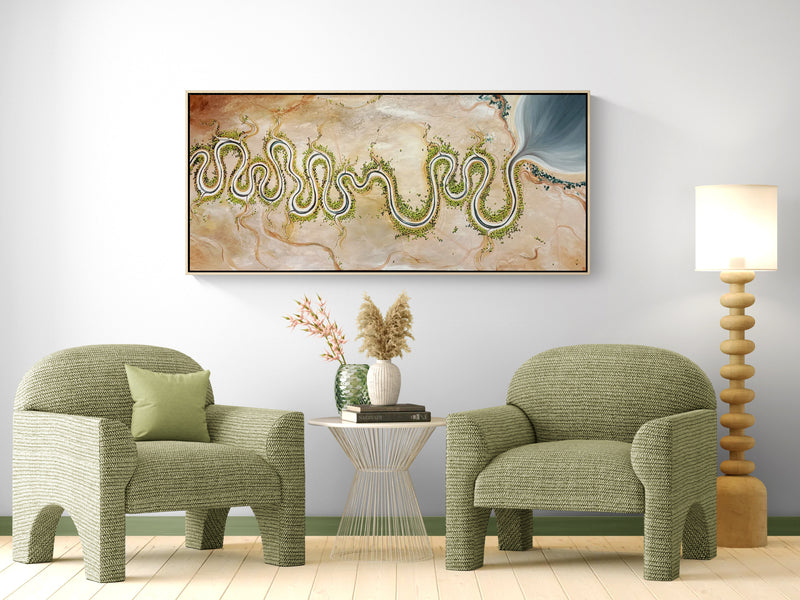
An aerial landscape compresses distance. Roads, tributaries, paddocks and coastlines become lines, patches and edges, making the subject naturally suited to abstraction.
Tania’s Meandering works offer several ways to explore this point of view. Compare Between Here and There, A Quiet Way Home and The Warmth of Distance. Even without standing in front of the paintings, the titles give you useful compositional cues to look for in the artwork images.
Pay attention to the direction of movement. A diagonal route can pull your eye through a room, while a broad horizontal composition often creates a steadier effect. Neither is universally better. The surrounding architecture decides which feels natural.
Atmospheric landscape paintings
Atmospheric work is less about mapping a location and more about conveying weather, light and distance. Soft transitions may suggest rain moving across land, a fading horizon or the subdued light before a storm.
Works such as Where the Earth Holds Your Heart, Beneath a Crimson Memory and The Weight of Memory can be considered through that lens. Open the individual pages side by side. Look at how much contrast each painting carries and where the lightest area sits.
A painting with its brightest passage near the centre tends to hold attention there. Light placed toward an edge can make the composition feel as though it continues beyond the canvas.
How to choose original abstract landscape art for your home
Use your emotional response as the first filter, then test the practical fit. Reversing that order often produces a painting that matches the cushions but never becomes personally meaningful.
Suppose you are considering Great Southern Land for a living room with a three-seat sofa, warm timber flooring and neutral walls. You are attracted to its sense of place, but the online image alone cannot tell you whether its physical proportions suit the wall.
Open the product page and note the listed dimensions. Use painter’s tape to mark that exact footprint above the sofa. Stand at the room entrance, sit in the usual viewing position and check the wall from an adjoining space if it remains visible.
Leave the tape in place overnight. Morning and evening light may change your judgement.
The most common error at this stage is choosing a work that is too small. Buyers often compare the painting with a blank section of wall rather than with the sofa, sideboard, bed or dining table beneath it. The artwork then appears disconnected from the furniture.
For a more detailed room-by-room process, use the artist’s guide to choosing the perfect art for your home. It covers the wider decorating decisions that sit around the artwork purchase.
Choose the right painting size
Measure both the available wall and the furniture below it. Record the maximum width and height rather than relying on a rough impression.
Allow for breathing space around the work. A painting should not feel squeezed between a doorway and a tall cabinet, and its lower edge should not sit so close to furniture that the two appear crowded.
Use this comparison to decide what to test in your room:
| Artwork format | Usually suits | What to check before buying | Common failure mode |
|---|---|---|---|
| Wide landscape | Sofas, beds, sideboards and long dining settings | Whether its width relates comfortably to the furniture below | Choosing a work so narrow that it appears to float |
| Square | Compact walls, reading areas and balanced furniture arrangements | Whether nearby objects make the wall feel too symmetrical | Treating a square work as filler for a long wall |
| Tall portrait | Narrow walls, stair landings and spaces between openings | Ceiling height and sightline from the main approach | Hanging it too high because the wall is tall |
| Large statement work | Living rooms, entries and open-plan areas | Viewing distance, access for delivery and wall fixings | Measuring the wall but not the route into the room |
| Small original | Shelves, studies, intimate corners or grouped displays | Whether it has enough visual space around it | Placing it alone on an oversized wall |
When considering large abstract paintings for sale, also measure the practical route. Check doors, hall turns, stairwells and lifts. A canvas may fit the final wall and still be difficult to move into the building.
Test the colour in your actual room
Screens alter colour. Brightness settings, warm display modes and surrounding light can make a painting appear cooler, darker or more saturated than it is.
Review the artwork on at least two devices if possible. Then look at the product images in daylight and again under the lamps used at night. This will not reproduce the physical painting, but it can reveal how strongly your screen settings influence what you see.
Do not force a precise colour match. A small variation between the painting and the upholstery usually feels more natural than an exact match. Look for relationships instead: a repeated warm undertone, a useful contrast or a dark note that anchors the room.
Tania explains more about the physical and expressive qualities of the medium in Abstract Acrylic. That background is useful when you want to understand how an image on a screen relates to a painted surface.
Use a room mock-up carefully
A room mock-up helps with scale and placement, but it is not proof of exact colour or texture. Use it as a planning tool.
Photograph the wall straight on, preferably without a wide-angle setting. Include the main furniture in the frame. Add the artwork image at the correct proportions, then compare at least two sizes or placements rather than making one mock-up and treating it as final.
The article on how to create in-room mock-ups explains the process from the artist’s perspective. If you make your own, check that you have not stretched the artwork image to fill the available space. Distorting its proportions gives you a false result.
Materials, surface and finish in original abstract paintings
Materials affect how a painting looks under changing light, how much texture is visible and how it should be cared for. Read the description on the specific artwork page because details can vary between works.
An acrylic painting may contain transparent passages, opaque areas, visible marks and layered colour. Those qualities are often difficult to capture in one front-facing photograph. Detail images can show changes in surface and edge quality that disappear in the main image.
When reviewing an original, confirm these points on its listing or with the artist:
- The painting medium and support
- The exact dimensions and orientation
- Whether measurements include any frame
- Whether the work is framed or ready to hang
- How the edges are finished
- What authenticity documentation accompanies it
Do not infer materials from appearance. A glossy-looking photograph may reflect the lighting used for documentation, while a visibly textured area may be subtler in person.
The support matters too. A stretched canvas has depth and can often be displayed without an external frame when its edges are intentionally finished, subject to the details of the individual work. Framing changes the overall dimensions and visual character, so confirm what is included rather than planning from the image alone.
How authenticity works when buying original Australian art
An original painting is the physical work made by the artist, not a reproduction of that image. If editions or printed products exist, they should be distinguished from the original work in their descriptions.
Check the title, artist attribution, medium, dimensions and any stated signature or documentation details. Save your order confirmation and the artwork description for your records. If a listing leaves an important point unclear, ask before purchasing.
Copyright and ownership of the physical object are separate. Buying a painting does not generally transfer the creator’s copyright unless that transfer is agreed in writing. The Australian Government’s IP Australia copyright guidance explains that copyright protects original expression and arises automatically.
Buying directly from the artist gives you a clear line back to the source of the work. Tania discusses the ideas and personal context behind her practice in Tania Talks About Her Art. That context does not replace the need to check product details, but it can deepen your understanding of the work you are considering.
How to buy an original abstract landscape from Tania Chanter
The website brings the selection process into one place, without requiring you to sort through unrelated artists and mass-produced wall decor. Start on Tania Chanter’s website, then move into individual artwork pages that match the mood and format you need.
First, open several works rather than committing to the first image that catches your eye. For our Great Southern Land example, keep that page open and compare it with another expansive composition such as The Overflow. This shows whether your preference is tied to a particular palette or to the broader feeling of open country.
Next, inspect the images and read the current details on each product page. Record the dimensions exactly. Mark both candidates on the wall with tape, one at a time, and photograph the result from the main seating position.
Then remove the weaker option. In this example, imagine The Overflow relates well to the room’s colours, but Great Southern Land creates the stronger sense of depth from the doorway. That is a valid reason to choose it. Art does not need to repeat the room’s dominant colour to belong there.
Before ordering, confirm the material, dimensions, availability, framing information and any delivery details shown on the current listing. If something relevant to your home is not stated, contact the artist before paying. This is especially important when access is tight or you need the work by a particular date.
Complete the purchase only after checking the final order information. Keep the confirmation and leave your wall markings in place until you have documented the planned hanging point.
This direct process removes the repeated filtering required on a broad marketplace. You are still responsible for measuring carefully, but every painting you compare belongs to the same artist’s body of work. That makes differences in mood, composition and colour easier to assess.
Buying direct from an artist versus an online art marketplace
Large marketplaces such as Bluethumb and Art Lovers Australia can be useful when you want to compare many artists, styles and price levels at once. The trade-off is volume. Search results may mix different materials, levels of experience, framing options and fulfilment arrangements.
Buying from an artist’s own website offers a narrower, more coherent selection. You can spend more time understanding the body of work instead of repeatedly resetting your judgement as the style changes from one artist to another.
Neither route removes the need to read the listing. On any site, verify what is original, what is a reproduction, what dimensions are supplied and whether framing is included. Check the vendor’s own current terms before placing an order.
Price alone is a weak comparison when the works differ in scale, materials, career context and presentation. Compare like with like. An unframed small work and a large finished original do not serve the same purpose, even if both appear in the same search results.
Commissioning an abstract landscape painting in Australia
A commission may be appropriate when you connect with an artist’s existing work but cannot find the right dimensions, orientation or general colour direction among the available pieces. It should not be treated as a way to order a copy of another painting.
Before asking about a custom work, prepare a clear brief:
- Wall dimensions and photographs of the room
- Preferred maximum artwork size
- Portrait, square or landscape orientation
- Examples of the artist’s existing works you respond to
- The mood and broad colour direction you prefer
- Any genuine deadline or access constraint
Explain what you like about each reference. “I like the open pale area and the dark line through Meandering River Plain” is more useful than “make it match my lounge.” It identifies visual qualities while leaving the artist room to create an original response.
Ask how the commission process works, what decisions can be agreed in advance and how much variation you should expect. Also confirm payment stages, timing, delivery, framing and what happens if the completed work differs from the mental image you began with.
That last risk deserves attention. Commissioning art requires trust because an original painting develops through the artist’s process. If you need exact control over every shape and colour, an available finished work is often the safer purchase because you can assess the actual result before buying.
Hanging a large abstract landscape painting
Plan the installation according to the work’s actual weight, size, hardware and wall construction. Plasterboard, masonry and timber-supported fixing points require different approaches. If you are uncertain about a large or valuable work, use an experienced installer.
Start by finding the visual centre rather than automatically placing the top edge at a convenient height. Art is often hung too high, particularly above furniture. The relationship between the painting and the object beneath it should feel intentional when viewed from normal standing and seated positions.
Use two fixing points where appropriate to help keep a work level, but follow the hanging hardware and installation requirements relevant to the particular painting. Check for electrical wiring and plumbing before drilling.
For practical placement guidance, read Hanging Paintings the Easy Way. Large works deserve extra care because small measuring errors become obvious across a wide horizontal edge.
Once installed, avoid prolonged direct sunlight, excessive moisture and positions close to strong heat sources. Dust gently using care appropriate to the stated materials. Do not apply household cleaners to the painted surface.
Common mistakes when buying abstract landscape art online
The first mistake is measuring from memory. A wall described as “roughly two metres wide” may include switches, furniture edges or door clearance that reduces the usable area. Measure it properly.
The second is relying on one styled room image. Mock-ups can communicate scale, but furniture and walls may not be represented at dimensions that match your home. Always return to the listed artwork measurements.
Another failure mode is waiting for every household member to have the same immediate response. Original art can take time to read. Agree on practical constraints first, then compare a short selection in the room rather than scrolling through dozens of unrelated works.
Do not overlook orientation. A tall painting can make a narrow wall feel purposeful, while a wide work can reinforce the line of a sideboard or sofa. Choosing by colour alone misses that architectural effect.
Finally, do not assume that “large” has a standard meaning. Use centimetres or the measurement unit stated on the listing, and check whether the dimensions refer to the artwork itself or the framed size.
FAQ about original abstract landscape art in Australia
Where can I buy original abstract landscape paintings in Australia?
You can buy through an artist’s own website, a gallery or a multi-artist marketplace. Buying directly from Tania Chanter’s website lets you compare available works from one Australian artist and review each painting on its individual product page.
How do I know whether a painting is an original?
Read the listing for a clear description of the medium, support, dimensions and artist. Check whether the item is described as an original work rather than a print or reproduction, and review any stated authenticity documentation. Ask before buying if the distinction is unclear.
Can I choose a landscape painting without seeing it in person?
Yes, but compensate for the limits of a screen. Confirm exact dimensions, inspect all available photographs, test the scale on your wall and read the materials and framing details. Ask questions about any feature that could affect your decision.
What size art should go above a sofa?
There is no single size that works for every sofa and wall. Mark the proposed artwork dimensions with painter’s tape and assess them against the sofa’s width, the available wall area and the viewing distance. Small works often need grouping, while a large horizontal painting can hold the space alone.
Are abstract landscapes suitable as statement art for a living room?
Yes. A statement work does not have to be bright or busy. Scale, contrast, movement and placement can give a painting presence. A restrained atmospheric work may become the focal point because of its openness rather than its colour intensity.
Can I commission a custom abstract landscape?
You can ask the artist whether commissions are currently available and suitable for the project. Provide wall measurements, room photographs, preferred orientation and examples of existing works you like. Expect a new work in the artist’s style, not an exact duplicate of an existing painting.
Should my painting match my furniture?
It should relate to the room, but it does not need to copy it. Repeated undertones, contrast and visual balance are usually more interesting than an exact match. Choose a painting you want to keep even if the sofa or wall colour changes later.
What should I check before ordering a large painting?
Confirm the artwork and framed dimensions, materials, weight if supplied, hanging information, delivery arrangements and the route into your home. Measure doorways, stair turns and lifts as well as the final wall.
Choose the painting you want to keep living with
Start with the works that hold your attention for more than a few seconds. Compare their physical dimensions, mark them on the wall and remove any option that fails the practical test.
Then return to the images. If one painting continues to draw you back, open its current product page, verify every detail relevant to the purchase and ask about anything that remains unclear. For buyers who value atmospheric Australian subjects and a direct connection with the artist, Tania Chanter’s original abstract landscapes offer a focused place to choose a lasting work.